Voters decide
Separate majorities in Boise and Garden City remain the democratic gate.
Proposal 001 · Municipal governance · Boise, Idaho
One continuous city, governed twice.
Boise and Garden City are one city run by two governments. One Boise makes them one, and it writes Garden City's council seat, its workers' jobs, its land-use code, and every public dollar into the law you actually vote on.
The proposition
Some things merge cleanly: one police command, one finance system, one permit counter. Some things stay separate on purpose: the roads district, the fire district, the schools. One Boise sorts every function into the right place and names who owns it.
The compact on the ballot is the whole government: the map, the worker rules, the transition code, the service owners, the opening budget, and the controls that fire the moment a promise breaks. You approve the finished plan, and that plan becomes law.
Separate majorities in Boise and Garden City remain the democratic gate.
All 80 non-elected employees transfer. No consolidation layoff for two complete fiscal years. Frontline positions remain protected through Year 4.
The named Garden City District holds 36,248 people across 15 whole precincts, including every precinct that carries Garden City population.
Appropriate $2,529,209 for implementation and restrict $4,985,729 for workers at certification: $7,514,938 set aside before transfer.
01 · Mandate
Idaho already gives two contiguous cities a route to merge, decided by a separate majority in each. One Boise completes that route and puts the entire bargain in the vote.
Fact The Census Bureau’s 2025 estimates place Boise at 238,429 residents and Garden City at 13,047: 251,476 people in the current service-planning baseline. The attached district map uses the 2020 Census blocks inside current municipal boundaries: 248,872 people.
Sources: Census QuickFacts: Boise, Census QuickFacts: Garden City, and 2020 Census block service.
The route Annexation under Idaho Code § 50-222 moves land across a boundary; it has no power to dissolve an incorporated city or carry its officials, debts, contracts, employees, and public duties into a successor. Consolidation under Chapter 21 does exactly that. It starts with matching council resolutions, or with petitions from 20% of each city's qualified electors, and then takes a separate majority in each.
Compact Idaho enacts one open Municipal Consolidation Compact Act for every consolidation of two or more contiguous general-law cities. No city name, county, population, distance, date, or form-of-government proxy closes the class. Boise and Garden City then adopt one identical, complete compact and put it before both electorates.
Public proof The plan you vote on is the exact plan that becomes law, and no one can quietly edit it afterward. Both clerks deposit identical copies of the complete package before either city adopts it, the county clerk verifies every file, and one altered character stops the election. From there, universal succession carries every asset, liability, contract, claim, record, employee, and public duty into the successor, whether or not a schedule happens to name it. How the ballot package is verified →
02 · The municipal seam
The municipal seam changes who receives a request, who applies a code, who sends a bill, and who answers for the result. One Boise removes that seam from municipal government.
Explainer 01
Compare the current municipal seam, the successor city, the adopted Garden City District, and the regional services that remain independent.
Loading the boundary map…
Current Boise and Garden City polygons come from the Ada County municipal-boundary service. The successor contains both.
2020 Census blocks are assigned to the current city and precinct containing each block’s internal point.
The Boise River line is locally stored, reproducibly simplified official hydrography from the IDWR/USGS NHD Flowline service. It orients the screen and never controls a legal boundary.
The locator overlay identifies the adopted district. district-block-assignments.json controls membership; population and representation files prove the calculation.
Immediately before deposit, the build uses the official city boundaries, precincts, and latest decennial Census, publishes every input, and locks the map and Garden City origin boundary into the package. The canvass activates that map and never redraws it.
Publish the municipal polygons, every block assignment, all precinct IDs, the calculation code, and the resulting deviations.
Official geometry and exact reproducible build · high confidence. The municipal features are authoritative source geometry; the successor union and adopted district are compact rules.
Last updated: July 21, 2026.
Download boundaries.geojson03 · Legal route
Chapter 21 can count two electorates and move municipal property. It cannot carry this workforce, hold Garden City's code for 36 months, seat a seventh council member, or wait for the fiscal-year line. The enabling act supplies each missing power through one statewide general law.
Current law Idaho Code §§ 50-2104 through 50-2106 require a separate election and majority in each city. Sections 50-2109 through 50-2111 transfer property, liabilities, obligations, and pending proceedings. Section 50-2110 keeps preexisting ad valorem debt on the territory already obligated for it.
Current § 50-2108 makes consolidation effective when the officer-election abstract is filed. Current § 50-2112 then extends Boise ordinances and repeals conflicting Garden City ordinances. Current § 50-701 permits four or six mayor-council seats. Those three rules are why the existing chapter cannot deliver this design unchanged.
Compact The statewide general law amends §§ 50-203, 50-701, 50-703, 50-1003, and 50-2104 through 50-2112; adds §§ 50-2114A and 50-2114B; continues PERSI service under title 59; and overrides conflicting §§ 55-306, 55-2004, 55-2006, and 55-2010 for the manufactured-home conversion rule. It authorizes seven district seats, automatic employee transfer, the 36-month transition code, an October 1 effective date, enforcement standing, and an elected Transition Council.
One law for every eligible consolidation The act supplies the same authority wherever two or more contiguous Idaho general-law cities consolidate under § 50-2101. The local compact supplies the name, seats, map, dollars, and schedules. That open statewide class answers Idaho’s ban on disguised local legislation; Planned Parenthood v. State requires a real, nonarbitrary classification, and One Boise uses one.
The voted package controls When two documents in the package could seem to disagree, the order is fixed: the statewide act, then the compact, then the specific attachment for the matter at hand. A clerk may fix an obvious typo or citation number, and only when no duty, dollar, date, boundary, or legal effect moves. Anything beyond that is an amendment, and an amendment goes back to the voters. How the ballot package is verified →
Explainer 02
Six enacted steps take One Boise from statewide authority to an October 1 transfer.
The Municipal Consolidation Compact Act supplies the representation, workforce, land-use, timing, and enforcement powers before either city calls the vote.
Idaho Code Title 50, Chapter 21 supplies initiation, two separate votes, succession, legacy-debt treatment, and the successor city.
The Municipal Consolidation Compact Act is a statewide general law under article XII, § 1 and avoids the local-law prohibitions in article III, § 19.
The package certificate fixes the map before compact adoption. The consolidation canvass activates it without a rerun. The officer election occurs on the first authorized date at least 120 days after the later of package certification or the canvass. Transfer occurs on the first October 1 that follows.
Residents, transferred employees, and Transition Area owners receive standing, injunctive relief, and attorney fees when a protected compact term is violated.
The statewide act takes effect before either city calls the consolidation vote. The identical byte-locked compact then wins separate city majorities, voters elect the successor government, and the elected Transition Council executes the October 1 transfer.
Existing law verified; enabling act and compact binding on enactment and approval · high confidence. Every authority, amendment, trigger, electorate, deadline, priority rule, and remedy is written into the operative legal attachment.
Last updated: July 21, 2026.
Download legal-process.jsonThe people who live here decide After transfer, the Garden City Territorial Electorate is every current qualified successor-city elector whose current registered residence lies inside both the current city limits and the immutable transfer-day Garden City origin polygon. Every other current qualified city elector belongs to the Boise Territorial Electorate. Later annexations outside that polygon join Boise’s electorate. A detached nonresident joins neither. Every current city elector belongs to exactly one. Ada County assigns the ballot from the registered residence point at registration close. Town of Lockport recognizes concurrent territorial majorities when government restructuring bears differently on distinct territorial constituencies.
The bargain survives intact Separate municipal approval, universal succession, the seven-seat structure and full-voting Garden City District seat, current-resident territorial amendment votes, workforce transfer, land-use and manufactured-home protections, debt and enterprise firewalls, the Dividend formula, and package identity are integral. A final pre-transfer judgment invalidating one stops transfer under a stripped package. After transfer, succession, title, contracts, employment, debt, and completed acts do not unwind; every remaining protection stays in force to the maximum lawful extent.
The successor mayor and seven district council members are elected before transfer. Once qualified, they are the Transition Council. The predecessor governments keep ordinary services running until October 1; the elected successor executes the compact voters already approved.
04 · Representation
The compact draws the first seven-district map. It keeps every current Garden City precinct together, adds contiguous Boise precincts, and reaches equal population without changing Boise's mayor-council form.
Map The current boundaries hold 248,872 people in the 2020 block file, so an ideal district of about 35,553. The Garden City District is precincts 1601, 1602, 1603, 1604, 1605, 1609, 1610, 1611, 1612, 1613, 1908, 1909, 1910, 1911, and 1912: 36,248 people, about 2% above the ideal.
Compact Seven geographic districts elect seven council members. The district name “Garden City District” is permanent. Its first map is part of the vote. The seven-seat structure, district election, name, transfer-day City Hall anchor, and maximum-extent rule can be reduced only by another proposition winning concurrent majorities in the current Boise and Garden City Territorial Electorates.
A real vote The Garden City District elects a full voting member of the council, with the same power to make motions, amend, sit on committees, and cast roll-call votes as anyone else in the room. Its permanent name, its City Hall anchor, its maximum-extent rule, and its transfer-day protections can be cut only by a proposition that wins concurrent majorities in the current Boise and Garden City electorates, the same two-key consent that created them.
The voted map controls The first map is fixed in the package before the vote and never redrawn afterward. The clerk builds it against the boundaries, precincts, and census then in force, and the canvass simply switches it on. Ordinary precinct housekeeping after that folds into the certified district lines rather than moving them, and any boundary change not yet legally effective waits until after transfer. The council election follows at least 120 days after the later of certification or the canvass.
Garden City stays represented Every rebalancing first holds the entire transfer-day Garden City territory together. If the exact solver proves that impossible under seven whole-precinct contiguous districts below 10% deviation, the named district keeps the transfer-day City Hall parcel and the maximum attainable former-Garden-City population while minimizing displaced precincts. The immutable origin polygon used to classify current territorial electors, Transition Area, utility firewall, Preservation Reserve, and Dividend share still cover the full transfer-day polygon.
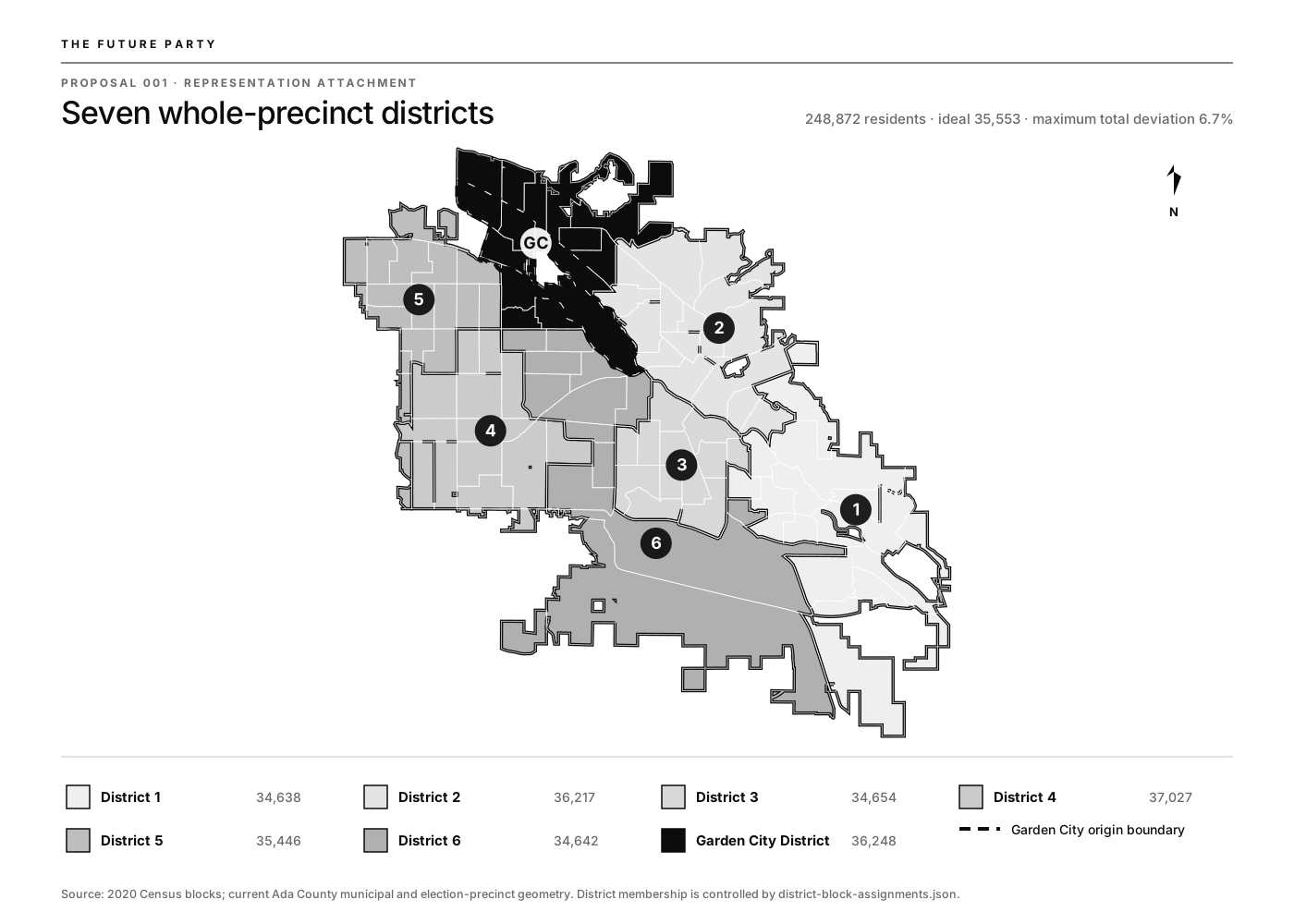
Explainer 03
Inspect the complete compact map: population, deviation, and whole-precinct assignment for all seven districts.
2020 Census blocks, current Ada County precincts, Idaho Code § 34-301, Idaho Code § 50-707A, Evenwel v. Abbott, Gingles, Bartlett, Louisiana v. Callais, Badillo v. City of Stockton, and the Supreme Court’s post-Callais Allen v. Milligan order.
Assign populated blocks by internal point, keep current precincts whole, require physical or enacted statutory contiguity, and minimize deviation under fixed nonracial rules. Fingerprint the assignment before demographic files open. Demographics audit the map; they do not draw it.
The smallest district is 34,638; the largest is 37,027; maximum total deviation is 6.7%, below the 10% presumptive federal threshold. Precinct 1702 has no physical or official precinct adjacency to 1519, so the statewide act supplies one statutory municipal-island edge between them. It adds no intervening or noncity territory.
The map is drawn without race, then audited against it. An exact search asks whether any protected group, alone or in the broadest coalition the Ninth Circuit has entertained, could form a voting-age majority in any district the rules allow. None can, under the official counts or a deliberately adverse citizenship-adjusted bound. The first Gingles gate fails, so Section 2 supplies no basis to alter the map by race. The exact margins and the reproducible certificate are in the verification annex.
The first map uses 2020 Census population and the official municipal and precinct layers certified immediately before deposit. That map enters the package and never reruns after the vote. ACS CVAP is allocated by PL voting-age share and tested against published margins of error.
Official population and geometry; exact map and voting-rights certificates · high confidence. Garden City is about 4.9% of the combined map and about 34% of the named district; every displayed value comes from the downloadable files.
Last updated: July 21, 2026.
Download population.json · representation.json · districts.geojson · district-block-assignments.json · voting-rights.json05 · Workforce compact
Move every employee intact. Use equivalent placement, captured vacancies, demand-backed growth jobs, insourced work, fixed transition assignments, and funded voluntary exchanges before the backstop. After two complete fiscal years, the guarantee closes any unmatched fixed-portfolio case. Five named command-and-administration authorizations end in Year 3; five in Year 4. Frontline capacity stays.
Binding compact terms
Explainer 04
Select a year to see the rule, the work, and the exact implementation milestone.
All 80 non-elected employees transfer on October 1; the five elected offices end. Boise benefits, payroll, continuous PERSI reporting, credentials, records, and the guarantee account activate the same day.
The public payroll roster contains 85 populated unique records: five elected officeholders and 80 transferable employees, 66 full-time and 14 part-time, including 13 part-time library employees. Rows 86 through 250 are blank display metadata and are excluded. The Idaho Statesman supplies the public-record context.
$4,985,729 covers 26 weeks of FY2026 non-elected salary, health, PERSI, and FICA plus the entire $418,414 audited cashable-vacation liability. The inputs come from the FY2026 budget and FY2025 audit.
The 80 enacted employee rows produce a $103,653.00 salary-differential ceiling and a $125,308.03 PERSI/FICA-loaded ceiling. The annual $195,390 restricted reserve leaves $70,081.97 above it. C10 Police Lieutenant is fixed at $162,254 from the exact published $158,142 Boise Lieutenant salary advanced by the 2.6% FY2026 general-staff factor; X11 Police Chief is fixed at $200,788.20 from Boise's $190,000 commissioned recruitment floor advanced through the adopted FY2025 city-staff 3% increase and FY2026 general-staff 2.6% factor. These are binding compact floors, not official Boise class minimums. The Water Supervisor enters verified Boise class 1761532, Utilities Manager, E16, with a Potable Water Distribution specialty; the official utility-operations record covers the work, and the protected $48.76 hourly transfer step exceeds the $40.77 hourly comparable. Boise's health-expense average produces an 80-FTE ceiling of $1,244,345.86; Garden City's existing health authority exceeds it by $223,819.14, so incremental health cost is zero.
The public roster prices the exact 10 named authorizations at $1,701,962.26 loaded: $975,269.05 ends in Year 3 and $726,693.21 in Year 4. The transition account funds up to 10 voluntary exchanges at $25,000 each, $250,000 in all, already inside the $445,390 pay-and-classification category. The maximum Year 2 backstop is $1,269,395.13 and is already funded.
Post the position ID, job family, growth measure or receiving authorization, transition deliverable, incumbent disposition, incentive or backstop payment, ended authority, exact avoided cost, and payroll/procurement substitution check.
The enacted 80-record crosswalk links each public title and transfer rate to a real Boise class specification and the official general or police floor, with compact-enacted current comparables for the command classes Boise does not publish in a current schedule. Hourly cost ceilings use 2,080 hours, or 2,184 for police officers, without claiming a part-time employee’s actual schedule. The $195,390 allocation pays Year 1 and becomes a standing annual reserve in Year 2 before the Dividend.
The enacted crosswalk contains 80 of 80 transferable payroll records. Universal succession independently transfers every covered employee.
Last updated: July 21, 2026.
Download workforce-transition.json06 · Service integration
A merger does not make police calls, utility accounts, permits, library patrons, records, parks, or regional obligations disappear. The compact hands every function to a named successor owner on transfer day.
Explainer 05
Choose a function to inspect its receiving owner, continuing work, employee rule, cutover, and financial treatment.
$70,464 verified recurring reduction
Voters elect the successor mayor and seven district council members before October 1. The elected body serves as the Transition Council.
Each function cites its own records. The matrix begins with municipal succession law, the Garden City FY2026 budget, the FY2025 audit, and the named official service authority for work that remains external.
Every function carries one successor owner, one appropriation, one case path, one records custodian, and one public acceptance test.
The prior working system stays live for a function until the receiving owner passes its cutover test. Other services and the legal transfer continue.
No vendor line, internal transfer, external authority, or continuing workload is booked as a merger saving.
The Unification Ledger posts each owner, budget, contract action, transferred record set, service standard, cutover result, and price.
Universal succession transfers the work first. The matrix then separates consolidation, protected local identity, continuing work, and external authority before assigning any fiscal treatment.
Binding service-owner matrix · high confidence. Every selected function displays its source links and confidence; no service is treated as vanished merely because administration consolidates.
Last updated: July 21, 2026.
Download departments.json| Function | One Boise treatment | What does not disappear |
|---|---|---|
| Garden City Police | The Boise Police Chief receives command, personnel, records, evidence, fleet, contracts, and appropriations on transfer day after the two published payroll, CAD, evidence, credential, and records tests pass. | Patrol coverage, sworn staffing needs, calls for service, evidence duties, and community relationships. |
| Planning + permitting | Boise Planning and Development Services administers the 36-month Garden City Transition Land-Use Code from transfer day; the final or automatic default codification takes effect on the third October 1. | Lawful uses, vested rights, active permits, hearings, inspections, and neighborhood-specific planning. |
| Utilities | One Boise Finance receives billing administration on transfer day while each water, sewer, and sanitation enterprise ledger, revenue, reserve, debt covenant, rate, and service territory stays ring-fenced. | Operations, maintenance, debt covenants, reserves, capital needs, and ratepayer restrictions. |
| Roads | One municipal counterpart for capital planning and advocacy. | ACHD’s independent highway-district authority. |
| Fire + dispatch | North Ada County Fire and Rescue and Ada County dispatch retain authority; after radio, CAD, run-card, address, mutual-aid, and records tests, One Boise becomes their single municipal counterpart. | Existing regional or external governance, staffing, assets, and service obligations. |
07 · Fiscal model
The adopted base funds $2,529,209 at certification, carries a maximum Year 2 backstop of $1,269,395, ends 10 named command-and-administration authorizations by Year 4, funds a $195,390 annual compensation reserve before the Dividend, reaches about $1,577,036 in annual recurring cash, and pays back in roughly 4.9 years.
Baseline Garden City’s posted FY2026 budget is $31,449,021: $11,714,000 general fund, $805,468 development services, $3,042,036 sanitation, and $15,887,517 water and sewer. The FY2025 audit reports $16,068,199 cash, $31,251,466 net capital assets, $6,241,875 current liabilities, and $3,497,366 unassigned general-fund balance.
Formula The recurring base is $70,464 from collapsing the five Garden City elected offices into one funded Boise seat, plus the loaded cost of the fixed portfolio: $975,269 for the five Year 3 authorizations and $726,693 for the five Year 4 authorizations. No workforce average or per-position cap enters the calculation.
Compact Boise appropriates the $2,529,209 transition account and its $1,488,363 share of the workforce guarantee at certification. Garden City restricts $3,497,366 from its audited unassigned general fund for the guarantee. Its separate $2,000,000 assigned operating balance stays intact. Total cash set aside before transfer: $7,514,938.
The $4,985,729 workforce guarantee is restricted cash security, held apart from transition spending. Boise's $1,488,363 is drawn first. The maximum fixed-portfolio draw is $1,269,395, which leaves about $3,716,334 restricted. Any Garden City-origin draw creates a successor replenishment obligation. At release, up to $3,497,366 enters the permanent Garden City District Preservation Reserve, and unused Boise-origin cash returns to the Boise General Fund. One-time reserve cash never enters the recurring Dividend.
Excluded from savings The $1,274,000 water-and-sewer transfer and $80,000 sanitation transfer are movements between funds. Prosecution ($215,000), animal services ($59,500), billing ($38,500), building inspection ($97,500), planning and engineering ($75,000), and the separate audit ($27,600) all carry continuing work. The adopted model books zero water, sewer, or sanitation savings. A later verified enterprise reduction stays inside the same enterprise and enters its next cost-of-service and revenue-requirement calculation; it never enters the General Fund or Dividend.
Garden City’s 2004 $860,000 City Hall and Library general-obligation bond matured on August 1, 2025; the FY2025 audit reports zero principal and interest outstanding at year-end. Every other legacy debt remains with its pledged territory, revenue, and assets under § 50-2110.
Explainer 06
The base is the compact. The conservative bound tests recognition failure after the same funded 10-role schedule executes. The higher bound adds five named administrative authorizations only after voluntary vacancy. Neither changes the adopted plan.
Princeton’s transition request supplies $1,703,591 across six 2011 categories. Official 2011 and June 2026 CPI values produce $2,529,209.
Published Princeton records show 17 positions from 267 and 26 from 287. One Boise's fixed 10 are about 0.5% of Boise's existing 2,133.25-position scale, roughly 90% below Princeton's lower rate, while all 80 non-elected Garden City employees transfer.
Base cash is −$1,425,687.54 through Year 4, +$8,036,528.94 through Year 10, and +$5,097,252 in present value at the July 20, 2026 Treasury yield of 4.60%.
Each saving requires position control, payroll, procurement, overtime, temporary-labor, contractor, and reclassification records for 24 months.
Adopted base. High confidence in audited balances, adopted appropriations, public-roster pay, benefit-rate arithmetic, and the maximum backstop. Modeled-high confidence in cash timing and payback because those outputs depend on the compact executing as written. The conservative and higher cases are sensitivities, not alternate plans.
Last updated: July 21, 2026.
Download fiscal-model.jsonThe Dividend executes every year Section 50-1003 ordinarily ends municipal appropriations at fiscal-year close. The enabling act supplies the exact exception. Each quarterly controller certificate of an actually realized current-year General Fund cash reduction automatically increases that year’s appropriation. Spending authority closes September 30; the restricted cash neither lapses nor reverts. At 12:01 a.m. October 1, the unspent restricted balance and certified recurring base are appropriated again by operation of law under 30/20/10/20/20. The annual ordinance displays the amount. Failure to print it is ministerial and cannot stop the appropriation.
The $1,577,036 recurring pool, once the $195,390 annual compensation reserve is funded, spread across 101,178 Boise households and 5,630 Garden City households, comes to about $14.77 a household. That is a way to picture the scale. What governs every certified dollar is the binding 30/20/10/20/20 allocation, whose 20% tax-relief share lowers the next lawful city levy under Idaho Code § 63-802. The relief follows the levy and budget framework, so it shows up as a lower levy rather than a fixed check.
Explainer 07
Apply the compact’s voter-protected 30/20/10/20/20 rule to every certified recurring general-fund dollar.
Only certified recurring general-fund reductions enter. Enterprise revenue, restricted money, internal transfers, asset sales, and unexecuted contract reductions stay outside.
30% Garden City District, 20% resident tax relief, 10% utility affordability, 20% workers and service capacity, 20% citywide accountability.
The controller certifies quarterly and the current annual appropriation increases automatically. September 30 closes spending authority, not the restricted account. At 12:01 a.m. October 1, the balance and recurring base are appropriated again by law. The annual external audit tests every transaction.
The sliders test arithmetic. They do not amend the voter-protected allocation.
Binding compact formula. High confidence in the 30/20/10/20/20 allocation arithmetic. Each year’s dollar pool is the controller-certified recurring General Fund reduction; no uncertified or enterprise dollar enters it.
Last updated: July 21, 2026.
Download dividend-model.jsonAn ended authorization is not a saving if the cost returns as a contractor, temporary hire, reclassification, overtime, or replacement authorization. The failed substitution check reverses the certificate and restores the Dividend category from the department that restored the cost.
08 · Land use and identity
Garden City's riverfront, mobile-home communities, live-work spaces, arts, wineries, breweries, and small businesses are the point of the place. The compact carries them into the new code exactly as they are, and gives the two zoning systems three years to become one without erasing anyone overnight.
Starting code Garden City adopted its new comprehensive plan on October 27, 2025 and amended it on April 15, 2026. Boise's modern zoning code took effect December 1, 2023. Garden City reports roughly 1,700 properties, about 74% of the city, in the 100-year floodplain.
Compact The enabling act creates a Garden City Transition Land-Use Code. For 36 months, Garden City’s comprehensive plan, development code, design rules, permits, development agreements, complete pending applications, floodplain rules, Greenbelt protections, and lawful uses control inside the Transition Area.
Every active case keeps its case ID, code-of-filing, fees, evidence, deadlines, approvals, and conditions. Nothing restarts, no fee is charged twice, and the successor code reaches backward only for immediate life-safety and environmental orders. An applicant can elect early conversion, and then the whole successor code applies to that case at once.
The compact’s protected-use register carries forward actual industrial, maker, live-work, studio, winery, brewery, tasting, repair, and fabrication uses. No lawful use becomes nonconforming because two governments became one.
The resident permit intake goes from nine municipal and agency touchpoints to one One Boise case. SAFEbuilt, DOPL, public works, stormwater, fire, ACHD, and every other required review remain. Garden City’s published first-review targets remain 10–15 working days for ordinary building permits and 21 or more for structural review until the unified code replaces them.
The statewide act imposes this rule directly notwithstanding Idaho Code §§ 55-306, 55-2004, 55-2006, and 55-2010. The current 180-day floor remains a floor; One Boise requires 365 days. Conversion includes closure, demolition, removal, disconnection, rezoning, subdivision, permitting, a sale conditioned on changed use, and the first act or filing that removes a residential space. An occupied space is one used as a principal residence then, during the prior 365 days, or before conversion ends. Nonrenewal, rent pressure, or service withdrawal cannot manufacture a vacancy.
One occupied space out requires one protected space inside One Boise, complete and ready for occupancy. It must take the resident’s home dimensions, section count, configuration, and construction date; preserve disability access and appurtenances; provide a lawful transport route; and carry a recorded five-year lease. Initial rent and mandatory charges cannot exceed the final pre-notice amount. Annual increases cannot exceed the lower of 6% or CPI-U West. Age alone cannot disqualify the home. These terms track enacted protections in Massachusetts and Oregon; the act makes them binding here.
A relocating household receives every documented move, repair, installation, access, appurtenance, storage, parking, and temporary-lodging cost plus at least $10,000 for a single-section home or $15,000 for a multi-section home. A rotating Idaho-licensed installer and engineer may find a home nonrelocatable only under the compact’s measured structural, code, route, site, or cost criteria. Then the owner pays in-place fair-market value plus the same minimum and still supplies the replacement space. Resident and owner select licensed appraisers. Within 10%, the mean controls; above 10%, a third appraisal is mandatory and the median controls. Before approval, cash escrow or an irrevocable Idaho-admitted surety bond secures the value, minimum, and highest responsive move bid. Any shortfall becomes a lien coequal with property tax and superior to other encumbrances, with judgment interest, resident enforcement, and attorney fees. No conversion permit, demolition, disconnection, or replacement-use occupancy advances before full performance. The duty is exact: one replacement for each occupied space, plus resident-specific cost or value, because Sheetz applies constitutional scrutiny even when a legislature imposes the condition.
09 · Regional coordination
Consolidation collapses the city's two seats at the regional table into one, and leaves the table itself exactly as it is.
ACHD retains road authority. Its local-government counterparts fall from seven to six: five cities plus Ada County. One Boise submits one municipal capital position.
VRT and COMPASS retain regional authority. Boise and Garden City’s two municipal seats, submissions, and positions become one when the governing records are updated before transfer.
North Ada County Fire and Rescue keeps its powers, assets, employees, levy, and service duties. Ada County dispatch keeps dispatch authority; its two municipal police customers become one after a live CAD cutover test.
Ada County, courts, elections, and state regulators retain authority. Garden City remains within its existing two school districts; municipal consolidation changes neither district.
The result is one municipal answer where today there are two. Independent governments remain independent. Their work is never counted as a municipal saving.
10 · Resident operating layer
The merger is finished the day a resident can see who owns a problem, what happens next, what it costs, and how to appeal. Combining the org charts is the easy part. This is the part that matters.
Twelve modules Resident services; parks, facilities, and community access; a filterable city calendar; mayor and council accountability; verified nonbinding Public Signal; district and affected-community surveys; a real-time budget dashboard; neighborhood investment; the Responsibility Map; end-to-end project tracking; public meetings and searchable civic media; and structured representative and department contact are binding acceptance results.
Permanent through utility Residents arrive to pay a bill, reserve a park, register for a program, follow a closure, or check a permit. The same system shows the vote, budget, survey, project, and responsible owner. Responsive web ships first; the mobile notification and location-aware layer follows; phone, counter, mail, language, disability, and assisted service always create the same authoritative record.
Explainer 08
Inspect every binding module. The operating layer joins daily civic utility to public ownership, evidence, deadlines, votes, and escalation.
One phone number, one counter script, one responsibility map, and one case-handoff rule operate across both former cities.
One searchable service directory and public case-status page cover every municipal function.
All twelve modules pass their published acceptance tests in the responsive web layer. Every offline channel creates the same authoritative record.
The mobile notification and location-aware layer is live. No resident submits the same fact twice. Legacy portals are read-only archives.
The founder’s twelve-pillar operating-layer design is incorporated into the One Boise compact. Interface acceptance uses WCAG 2.2.
Each module has a fixed resident journey, owner, record, deadline, evidence, privacy rule, offline equivalent, and pass/fail acceptance test. One verified resident identity supplies residency and district without exposing the address publicly.
Public Signal and survey identity, address, and individual response remain private. Only aggregates publish with wording, timing, method, citywide or defined-area result, and the later official action.
Binding compact specification · high confidence. These are policy commitments with fixed delivery deadlines, not forecasts or optional features.
Last updated: July 21, 2026.
Download operating-layer.json11 · Implementation
The compact begins at 12:01 a.m. on October 1. The successor government executes a fixed four-year sequence and posts every action to the Unification Ledger.
Fund the $2,529,209 transition account and $4,985,729 workforce guarantee. Open the Unification Ledger and publish every compact attachment.
Move all 80 non-elected employees, every fund, record, case, asset, contract, and service owner. Finish every employee classification and appeal by fiscal close.
Close every transition assignment. Route employees through equivalent placement, captured vacancy, growth retention, insourced work, or voluntary exchange. After the complete two-year term and final appeal, execute the funded backstop for any fixed-portfolio incumbent still unmatched.
End the City Attorney, Clerk/Treasurer, Chief of Police, Public Works Director, and Development Services Director authorizations. Publish every disposition and substitution check. Activate the unified land-use map on the third October 1.
End the Administrative Lieutenant, Patrol Lieutenant, IT Manager, Accounting Manager, and Police Department Administrator authorizations; close temporary transition systems; certify every service test; complete the fourth fiscal-year audit.
Certify recurring reductions and appropriate them at 30/20/10/20/20. Reverse any saving whose cost returns through another channel.
Every transition action carries an owner, an authority, a deadline, an appropriation, a fund restriction, a contract, a source record, an acceptance test, a cost, a result, and the control that fires if it fails. Personnel and security data stay private; everything else is open to read as it happens. This is open contracting pointed at a government merger, so residents watch the transfer instead of trusting a report about it later.
12 · Failure modes and automatic controls
The successor city clerk posts the breach. Residents, transferred employees, and Transition Area owners have standing for declaratory and injunctive relief plus attorney fees. A protected term can be reduced only by concurrent majorities in the current Boise and Garden City Territorial Electorates.
The named receiving owner keeps the prior working system live for that function and corrects the cutover against the published acceptance test. Legal transfer and every other service continue.
The human-resources director holds the challenged placement. The guarantee account funds continuity while the independent hearing officer decides the appeal on the evidence.
The compact’s self-executing GC- codification controls that parcel. Existing geometry, lawful use, capacity, approval, condition, agreement, overlay, and procedural rights remain fixed.
Planning and Development Services denies the permit. Demolition and utility disconnection remain barred; the escrow or bond stays enforceable; unpaid amounts become a lien with statutory interest. One occupied space out requires one protected space in.
The controller reverses the saving certificate. The department that restored the cost restores the corresponding Dividend appropriation. The ledger shows both transactions.
The city clerk and IT director keep the source system live or read-only, preserve its custody record, and repeat the failed acceptance test before retirement.
The resident-services director restores the equivalent phone, counter, mail, language, disability, or assisted-service channel. Each channel creates the same case, deadline, status, and appeal.
The controller reverses the transfer, restores the enterprise balance with lost earnings, and charges the correction to the responsible appropriation.
The levy schedule is corrected before certification. Every affected taxpayer account receives principal and statutory interest automatically.
13 · Sources and method
The paper, eight explainers, formal document, downloadable data, and Relay record use the same source and calculation layer.
Version 1.0 · July 21, 2026. Every quantitative claim in this edition is copied from a cited record or calculated from cited inputs. The data files expose the formulas, and the changelog records every material revision. You are not asked to trust any of it. You are asked to check it.
Annex · How the ballot package is verified
Most ballot questions are a single sentence. This one is a package of fifteen files: the map, the budget, the worker crosswalk, the transition code, the service owners, and the controls. Because the package is the law, it has to be impossible to swap a file after voters approve it. Here is the machinery, for anyone who wants to check it.
Deposit and identity Before either city adopts the compact, both clerks deposit identical copies of all fifteen files with the Ada County Clerk and the Idaho Secretary of State. A separate manifest lists every file, its size, and its SHA-256 hash, the cryptographic fingerprint that changes completely if a single character changes. The manifest describes the fifteen files but never itself, so its own hash becomes the one short identifier for the whole package, printed on both ordinances, the joint resolution, the ballot notice, the ballot, and a detached receipt.
The check The county clerk recomputes every hash from the deposited files and compares them to the manifest. One mismatch stops the election. Change anything before the vote and the whole adoption clock restarts. Change anything after the vote and it is an amendment that goes back to the voters. A clerk may fix an obvious typo or citation number, and only when no duty, dollar, date, boundary, or legal effect moves.
The order of control If two documents could seem to disagree, precedence is fixed: the statewide act, then the compact body, then the specific data attachment for the matter at hand. Within a domain, the block-assignment file controls district membership and population, the district GeoJSON controls display geometry, and the boundaries file controls the origin, successor, and Transition Area boundaries. Population, representation, voting-rights, and source files are evidence. This page and the formal PDF explain the package and create no duty of their own.
The voting-rights margins Chapter 4 states the result: no protected group, alone or combined, can form a majority in any district the rules allow. The exact search runs across every whole-precinct grouping from 31,998 to 39,108 residents and maximizes each group's majority margin. Every one comes back negative: Hispanic −17,659, Asian −19,779, Black −22,547, American Indian or Alaska Native −23,171, Native Hawaiian or Pacific Islander −23,263. A deliberately adverse citizenship-adjusted pass leaves the largest Hispanic margin at −3,492 and every other group at or below −9,233, and the broadest nonoverlapping coalition still fails at −11,261 by voting-age count. Full data: voting-rights.json.
Build One Boise
Organize the statewide enabling act. Secure identical city compact ordinances. Elect a successor government committed to the four-year sequence. Publish every receipt.
Build One BoiseCheck the work first. Then help build it.